Explore our compression technology platforms, low-GWP refrigerant compatibility matrix, and R&D capabilities that drive measurable performance improvements across every compressor product line.
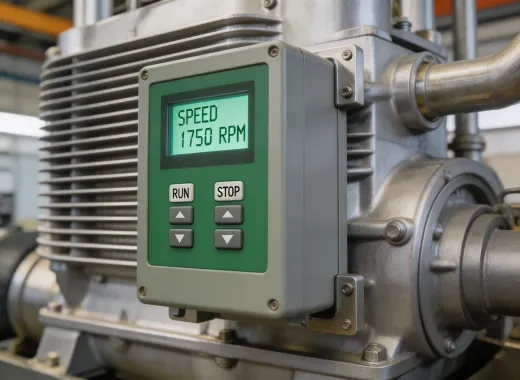
Every Embraco scroll and screw compressor platform supports integrated variable frequency drive (VFD) control, enabling precise capacity modulation from 25% to 100% of rated output. Unlike fixed-speed compressors that cycle on/off, VFD-equipped compressors continuously adjust speed to match real-time thermal loads.
The result: 30-45% energy reduction at typical part-load conditions, reduced mechanical stress from soft-start operation, and tighter temperature control with ±0.3°C precision at setpoint.
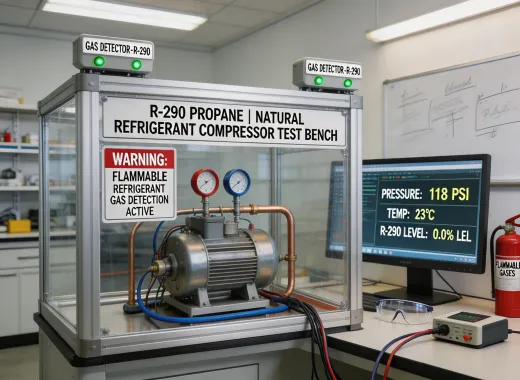
Embraco compressors are engineered for the full spectrum of low-GWP alternatives mandated by the Kigali Amendment and EU F-Gas Regulation. Our R-290 (propane) platform serves commercial display and light commercial applications, while R-744 (CO2) transcritical compressors address supermarket and industrial refrigeration requirements.
For existing infrastructure requiring retrofit compatibility, our R-1234ze and R-454C compressor lines provide drop-in or near-drop-in transitions from R-134a and R-404A systems with minimal piping modifications.
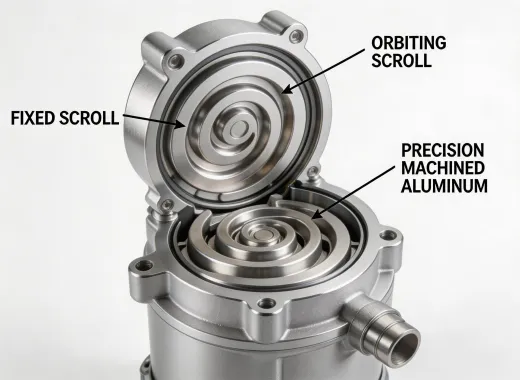
Our scroll compressor platform uses orbital scroll geometry optimized through computational fluid dynamics (CFD) analysis to minimize internal leakage losses and maximize volumetric efficiency. The result is a flatter efficiency curve across the operating envelope compared to reciprocating alternatives.
Key design features include compliant scroll mechanisms that tolerate liquid slugging without mechanical damage, vapor injection ports for enhanced heating capacity at low ambient conditions, and asymmetric scroll wraps that reduce pressure pulsation and acoustic noise.
Honest engineering requires acknowledging that no single technology is optimal for every application. Below are two key selection decisions our application engineers help customers navigate.
The Kigali Amendment (adopted 2016, HFC phase-down schedules effective from 2019) and the revised EU F-Gas Regulation (517/2014, updated 2024) are driving the global shift away from high-GWP HFCs. System designers face a fundamental choice between two transition pathways:
Zero or near-zero GWP (R-290 = 3, R-744 = 1), no patent dependencies, and lower long-term operating costs at scale. CO2 transcritical systems are increasingly viable even in warmer climates above 35°C ambient, with parallel compression and ejector technology closing the efficiency gap. However, R-290 carries A3 flammability classification requiring charge limits (typically 150g per circuit for commercial equipment per IEC 60335-2-89), and R-717 (ammonia) is toxic at concentrations above 25 ppm, restricting its use to engine rooms with gas detection systems.
Drop-in or near-drop-in compatibility with existing R-134a and R-404A infrastructure reduces retrofit costs by 40-60% compared to full system redesign for naturals. A2L low-flammability ratings simplify code compliance. The existing technician workforce requires minimal retraining. However, HFOs degrade into trifluoroacetic acid (TFA) in the atmosphere, raising long-term environmental persistence concerns. Patent protections by chemical manufacturers also create supply chain concentration risk and higher per-kilogram refrigerant costs ($15-40/kg vs. $3-8/kg for naturals).
Embraco provides compressor platforms for both pathways. Our application engineers assess your facility constraints, charge limits, local regulations, and total cost of ownership to recommend the appropriate refrigerant strategy.
Inverter-driven compressors offer modulating capacity control, but the capital cost premium (typically 25-40% over fixed-speed equivalents) means the breakeven point depends on load profile, energy prices, and application type.
30-50% energy savings at part load (verified per AHRI 550/590 part-load testing protocols), precise temperature control (±0.3°C), soft-start reduces inrush current to <2x FLA (vs. 6-8x for direct-on-line). Payback typically under 2 years for variable-load applications such as data centers, display cases with door openings, and facilities with significant day/night load swings. Downsides include higher harmonic distortion on power supply (requires input line reactors or active filters on units >15 HP) and more complex controls requiring trained service technicians.
Lower capital cost, simpler controls with standard contactors and thermal overloads, easier field service with widely available replacement parts, and proven long-term reliability exceeding 80,000 operating hours in constant-load applications. Fixed-speed compressors remain the cost-effective choice for ice making, blast freezing, and industrial process cooling where the thermal load is relatively constant and the compressor operates near full capacity >80% of the time. No harmonic concerns and no specialized VFD service skills required.
The right choice depends on your load profile. Our engineering team provides payback analysis based on your actual operating data — contact us for a complimentary assessment.
Performance characteristics across Embraco compressor platforms for key selection criteria.
| Parameter | Scroll | Screw | Semi-Hermetic | Hermetic |
|---|---|---|---|---|
| Capacity Range | 1 – 40 HP | 30 – 120 HP | 3 – 60 HP | 0.5 – 5 HP |
| Peak COP | 4.8 | 5.5 | 4.2 | 3.8 |
| Evap. Temp. Range | -25°C to +15°C | -40°C to +15°C | -45°C to +10°C | -35°C to +10°C |
| VFD Compatible | Yes | Yes | Select models | No |
| Field Serviceable | Limited | Yes | Yes | No |
| Sound Level | <62 dB(A) | <75 dB(A) | <68 dB(A) | <48 dB(A) |
| Low-GWP Refrigerants | R-290, R-454C, R-1234ze | R-744, R-717, R-1234ze | R-744, R-290, R-454C | R-290, R-600a |
Every compressor technology has defined operating boundaries. Understanding these limits is essential for reliable system design.
R-290 (propane) compressors are subject to A3 flammability charge limits per IEC 60335-2-89 and local building codes. Typical maximum charge is 150g per refrigerant circuit for commercial self-contained equipment, limiting R-290 applicability to systems below approximately 2 kW cooling capacity per circuit. Larger systems require multiple independent circuits or alternative refrigerants such as R-744 or R-717.
All air-cooled compressor systems experience capacity derating at elevated ambient temperatures. Embraco scroll and screw compressors are rated for operation up to 55°C ambient, but cooling capacity decreases approximately 1.5-2.0% per degree above the 35°C standard rating condition (per AHRI 540). Systems in hot climates above 45°C should be specified with 15-25% additional compressor capacity to maintain target evaporating temperatures.
Scroll compressors are optimized for medium-temperature applications (-25°C to +15°C evaporating). For low-temperature applications below -25°C, compression ratios exceed the efficient operating range of single-stage scroll geometry, resulting in elevated discharge temperatures and reduced volumetric efficiency. Applications requiring evaporating temperatures below -30°C should specify semi-hermetic reciprocating or screw compressors, or cascade system configurations.
Variable frequency drive (VFD) equipped compressors above 15 HP generate harmonic distortion (typically 35-45% THDi without mitigation) that can affect sensitive equipment on shared electrical systems. Installations in facilities with medical imaging, precision measurement, or other harmonic-sensitive equipment require input line reactors (3-5% impedance) or active harmonic filters to maintain THDi below 8% per IEEE 519-2022 recommended limits.
Download datasheets, performance curves, and application engineering guides for every compressor platform.
Request Technical Package